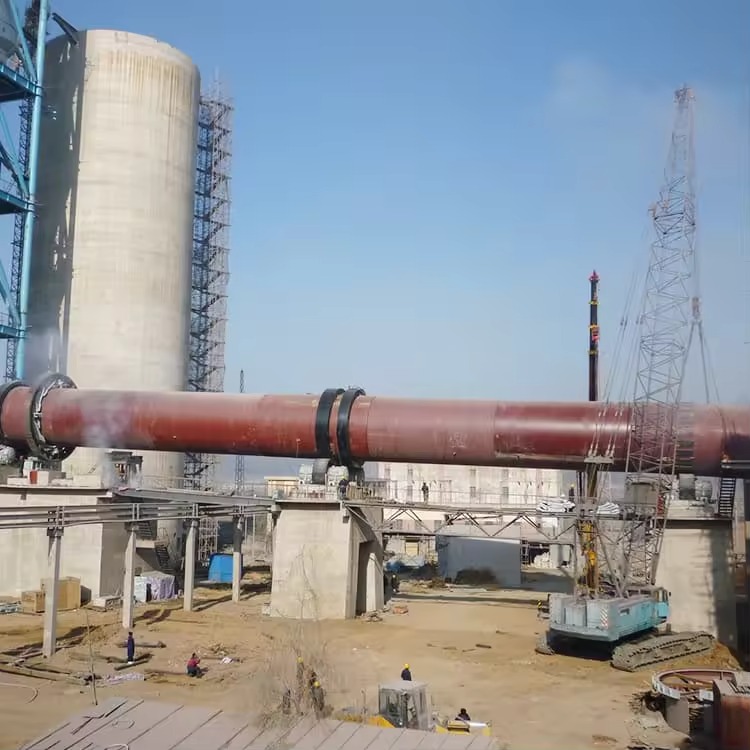


I’ll be honest — when my editor first asked me to write about industrial heating processes, I literally groaned out loud. Like, how exciting can “rotating cylinders that heat stuff” really be? Turns out, pretty damn interesting once you actually dig into it. Give me a second here.
The Heat Zone Nobody Really Talks About
Most people in manufacturing or construction materials know what a rotary kiln is, but ask them what actually happens inside during operation and you’ll get a lot of vague hand-waving. That’s exactly why understanding the rotary kiln pyroprocessing guide concept matters more than most engineers give it credit for. Pyroprocessing is basically the science — and a little bit of art honestly — of using controlled, high-temperature heat to transform raw materials into something completely different at a chemical and physical level. Cement clinker, lime, iron pellets, even some ceramics — they all go through this process.
Think of it like baking, but instead of 180°C in your home oven, you’re talking temperatures pushing past 1400°C and the “batter” is literally crushed limestone spinning around in a massive steel drum. It’s violent, precise, and somehow both at the same time.
Why the Kiln Rotates and What That Actually Does
Here’s something I didn’t know until fairly recently — the rotation isn’t just to move material from one end to the other. It’s also about creating consistent exposure to heat. If the material just sat there without moving, you’d get uneven burning, hot spots, and essentially a product that’s garbage. The slow rotation (and we’re talking like 1–5 RPM usually, not fast at all) creates this tumbling effect where material constantly falls over itself and gets re-exposed to the flame and hot gases. It’s weirdly elegant when you visualize it.
The kiln is also slightly inclined — maybe 3 to 4 degrees — so gravity naturally pulls material toward the discharge end as it rotates. Simple, effective. No conveyor belts, no mechanical pushers needed inside. Just physics doing its thing.
The Temperature Zones Are Where It Gets Nerdy
Inside a rotary kiln, the temperature isn’t uniform across the length — it follows distinct zones that each do something specific. There’s the drying zone near the feed end, where moisture gets kicked out first. Then comes the preheating zone, the calcining zone (where the real chemistry happens, CO2 gets driven off from limestone for example), and finally the burning or clinkering zone right near the flame. Each zone serves a purpose, and disrupting one messes up everything downstream. It’s honestly more like an assembly line of chemical reactions than just “hot air making stuff hard.”
One stat I came across while researching this — in cement production alone, pyroprocessing accounts for somewhere around 90% of the total thermal energy consumed in the entire plant. Ninety percent. Everything else — grinding, blending, packing — is almost negligible in comparison. That’s wild when you think about the energy bills these plants are dealing with.
The Seal Problem (More Important Than You’d Think)
Okay so this is something that barely gets mentioned in generic articles but it genuinely matters a lot in real operations — the seals. At both ends of a rotary kiln, where the rotating drum meets the stationary hoods, you need seals that can handle serious temperature differentials, mechanical movement, and constant wear. A bad seal doesn’t just cause heat loss. It lets in false air, messes up the internal atmosphere of the kiln, increases fuel consumption and can seriously affect the quality of the final product.
I’ve seen discussions on a few engineering forums where plant managers were losing serious money on fuel costs before they realized a degraded seal was the culprit. It’s one of those problems that sneaks up on you slowly rather than announcing itself with a loud bang.
Real Talk About Efficiency
Running a rotary kiln efficiently is like trying to keep a campfire going in the rain while also making sure it doesn’t burn too hot or too cool — constantly adjusting, constantly monitoring. Modern kilns use sophisticated sensors and control systems, but at the end of the day there’s still a lot of operator judgment involved. Feed rate, fuel type, rotation speed, draft pressure — all of these interact with each other. Change one and something else shifts.
There’s also the fuel flexibility angle that’s getting more attention lately. Kilns that were built to run on coal are increasingly being adapted to use alternative fuels like refuse-derived fuel, biomass, or even old tires. Tire-derived fuel, apparently, has a calorific value similar to coal and has been used in cement kilns for decades. Not sure I’d want to be standing downwind of that facility, but hey, waste diversion is waste diversion.
This Stuff Is Older Than You Think
The rotary kiln was patented way back in 1885 by Frederick Ransome. Over 135 years later, the basic concept hasn’t changed dramatically. We’ve gotten better at materials, controls, and efficiency — but the fundamental idea of a slowly rotating, inclined, externally fired cylinder is still the workhorse of global cement and lime production. There’s something almost stubborn about that kind of longevity. Like, the industrial world tried to find something better and just… couldn’t.
Next time you’re near a construction site, look at the concrete. Some part of that material spent time inside one of these massive, spinning, fire-filled machines. Kinda puts things in perspective, doesn’t it.