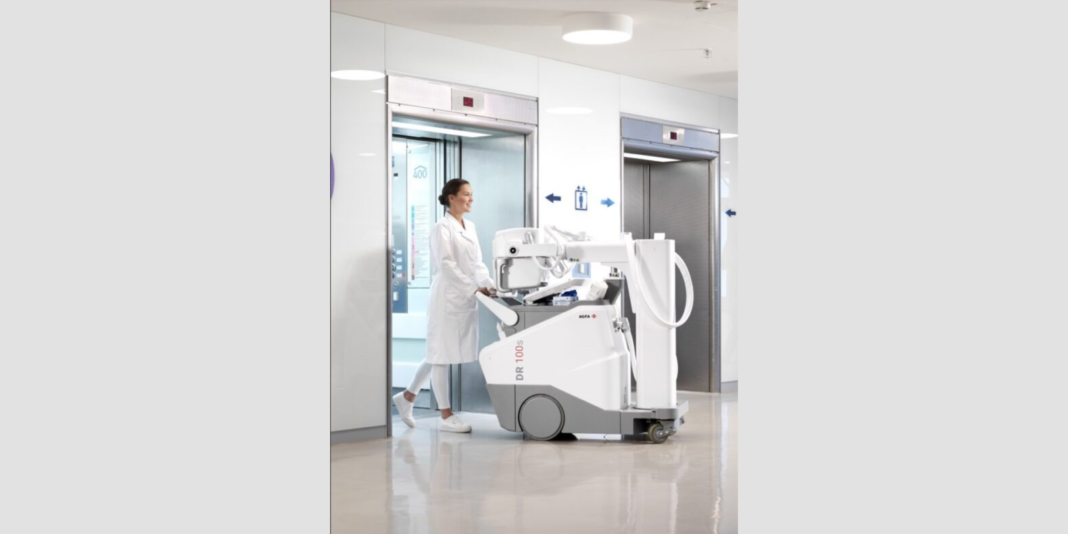


Radiographers in 2025 face an increasingly complex imaging landscape. Rising patient volumes, expanding clinical pathways and heightened expectations around accuracy and speed mean that today’s departments must rely on smarter, more adaptive digital radiography systems. Modern DR technology is no longer about image capture alone; it is about workflow optimisation, reducing physical strain, and supporting the radiographer in delivering consistent diagnostic quality across every care setting.
Intelligent DR ecosystems are at the heart of this transformation. They integrate automation, AI-supported functions, an ergonomic design, and seamless interoperability to help radiographers work more efficiently and confidently in every situation that may arise-emergency, mobile, outpatient, or high-throughput general X-ray.
Mobile Imaging: Bringing Speed, Precision, and Consistency to the Bedside
Mobile radiography continues to expand due to the growth in the needs of intensive care, emergency departments, and isolation units. Systems such as the DR 100s have been designed particularly with these environments in mind, offering a balance of manoeuvrability, power, and imaging intelligence.
For the radiographer, this means smoother workflows at the bedside: precise motion control, automated positioning aids, and fast image preview reduce the number of retakes and limit the physical effort involved in high-pressure rounds. An intuitive interface on advanced mobile units takes the complexity out of machine navigation, freeing staff to devote their energies to clinical care.
The result is a consistent imaging experience-even when challenges mount and space is limited, patient condition fluctuates, and time-to-diagnosis is critical.
Extending the Life of Existing Infrastructure with Smart Modernisation
Not every healthcare facility can immediately overhaul its entire imaging fleet. This is where intelligent modernization tools are proving invaluable, such as DR Retrofit solutions. Upgrading an existing analogue or older digital room with DR technology means a hospital can introduce high-performance image processing, workflow automation, and improved dose management without replacing their entire system.
Retrofit upgrades for radiographers greatly reduce friction: instant image availability, better ergonomics, and automatic workflow shortcuts eliminate the delays that are often associated with older systems. The ability to maintain familiar room configurations while gaining new features also reduces the learning curve, thus enabling smooth transitions by staff with minimal disruption to patient throughput.
These upgrades create an environment whereby radiographers can carry out more examinations in less time, more consistently, using less physical effort.
Consistent Room-Based Imaging for High-Volume Departments
For fixed imaging rooms with heavy workloads each day, intelligent DR rooms like the DR 400i bring structured efficiency and reliable consistency. High-volume departments benefit from various features, including automated tube tracking, pre-set positioning parameters, and integrated exposure control, all designed to minimize superfluous movements and free the radiographer to perform examinations more efficiently.
Built-in intelligence in the system maintains image quality, regardless of radiographer experience. From orthopaedics and chest studies to spine imaging and general X-ray, radiographers can trust the stable performance and optimised workflows that let them make fast clinical decisions.
Building a Consistent Workflow Across Diverse Imaging Environments
One of the biggest drivers of radiographer efficiency is the ability to move between different imaging setups without losing speed or consistency. When mobile units and fixed rooms and upgraded digital systems share similar interfaces, automation features, and workflow logic, radiographers are able to work with more confidence and far fewer interruptions.
This level of harmony across equipment helps to streamline training and reduce variability in image capture, thereby maintaining steady quality regardless of where the examination is performed. The outcome of this is reduced repeat images, greater comfort for the patient, faster interpretation times, and an overall smoother clinical pathway-each one an important advantage in today’s time-pressured healthcare environment.